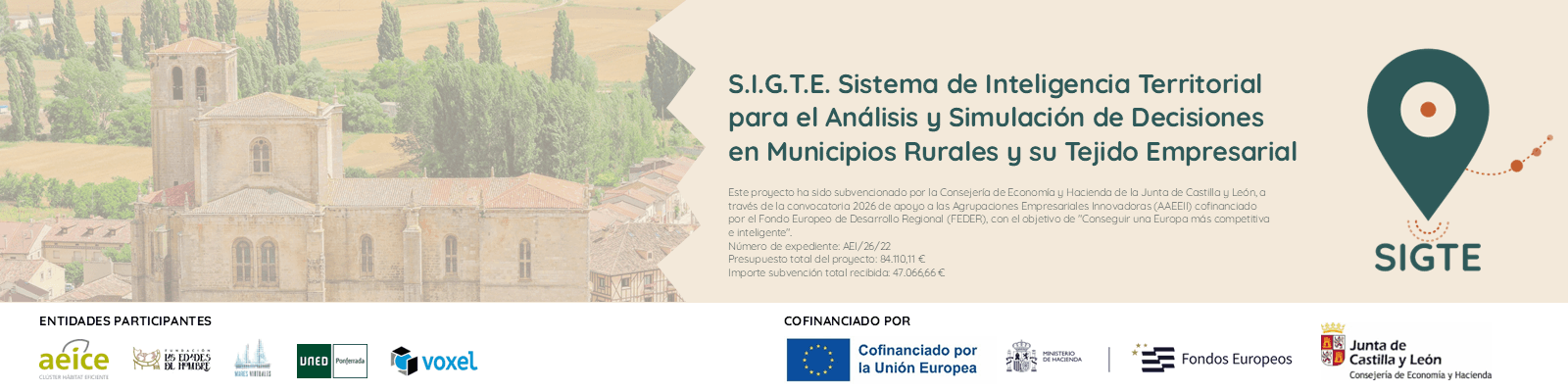
SIGTE
Territorial Intelligence System for the Analysis and Simulation of Decisions in Rural Municipalities and Their Business Ecosystem
SIGTE investigates territorial models, simulations of people flows and artificial intelligence to support decisions in rural municipalities with cultural heritage.
- Project reference
- AEI/26/22
- Total project budget
- 84.110,11 €
- Total grant awarded
- 47.066,66 €
Project summary
S.I.G.T.E. aims to develop a methodological and technological framework to analyse, model and simulate people flows in rural municipalities with cultural heritage. The project will investigate new territorial characterisation methodologies, structured digital models, simulation algorithms and predictive models based on artificial intelligence, to improve understanding of the dynamics of these environments and provide advanced tools to support municipal and business decision-making.
The results will focus on generating knowledge, validating it in representative environments and transferring it as a methodology that can be replicated in other municipalities in Castile and León.
Objectives
- Define a dedicated framework for the typological characterisation of rural municipalities with cultural heritage.
- Design a structured digital model of the territory, forming the basis of a conceptual digital twin, with a modular and scalable architecture.
- Develop algorithms for the dynamic simulation of people flows, including high-attendance events and emergencies.
- Develop predictive models based on artificial intelligence adapted to environments with low data density.
- Validate the system through demonstrators in relevant environments and generate tools to support municipal and business decisions, replicable in other municipalities.
Expected results
- SIGTE methodological framework and territorial classification system.
- Integrated digital territorial model.
- Report on the dynamic simulation of flows and scenarios.
- Validation report for the models in simulated operational environments, using the Duero territory as a case study, and a replicable methodological framework (TRL 5).
Consortium members
- AEICE (coordinator)
- Fundación Las Edades del Hombre
- MARES Virtuales
- UNED-Ponferrada
- VOXEL3D
Co-funding
This project has received a grant from the Regional Ministry of Economy and Finance of the Junta de Castilla y León through the 2026 call supporting Innovative Business Clusters (AAEEII), co-financed by the European Regional Development Fund (ERDF), with the objective of “A more competitive and smarter Europe”.